Karrakatta
Urban Design, Master Planning, wetlands, green corridors, walkable neighbourhood, biodiversity, tree canopy, aquifer recharge, hydrology, badgir, future climate, sustainable infrastructure, competition.
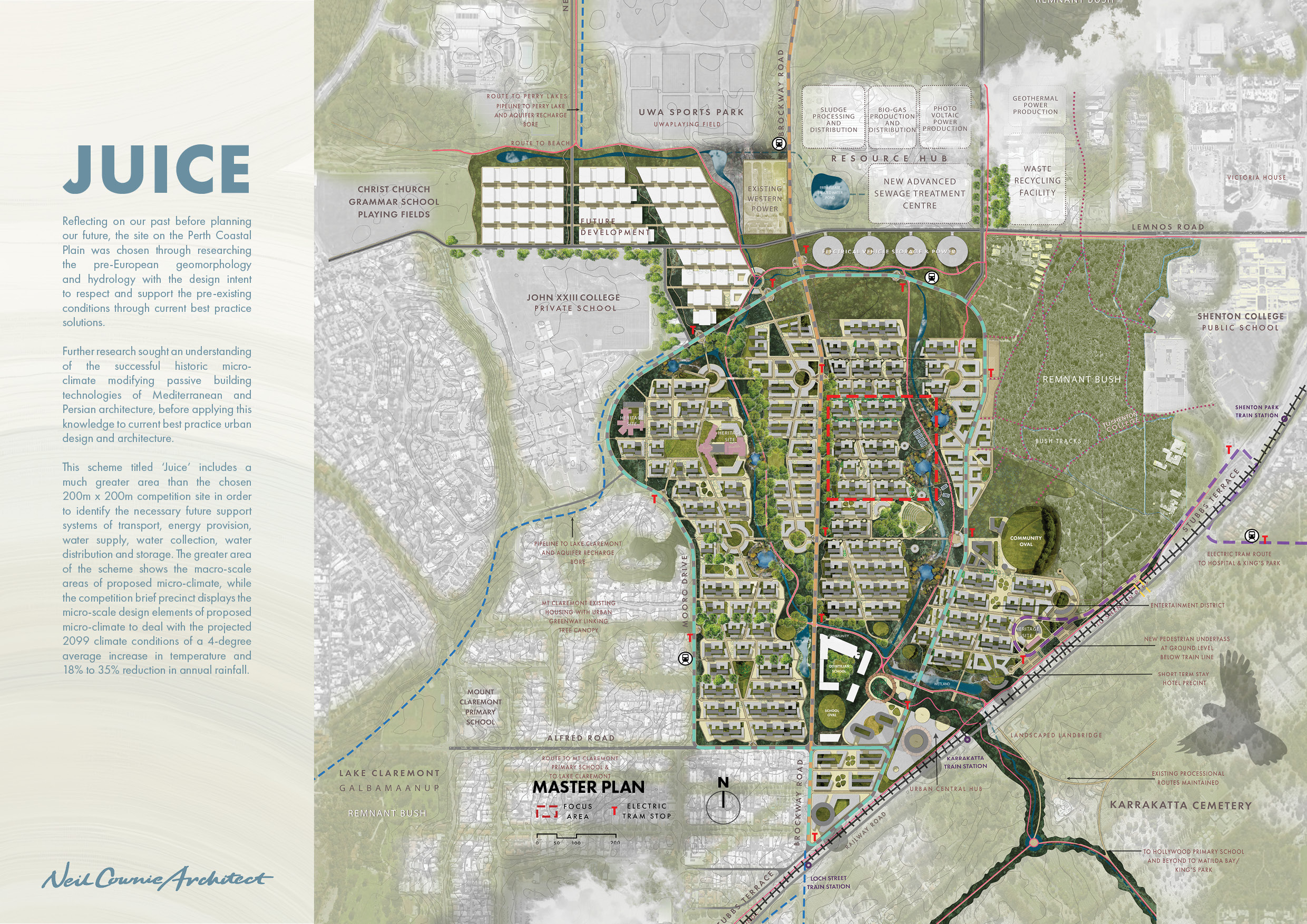
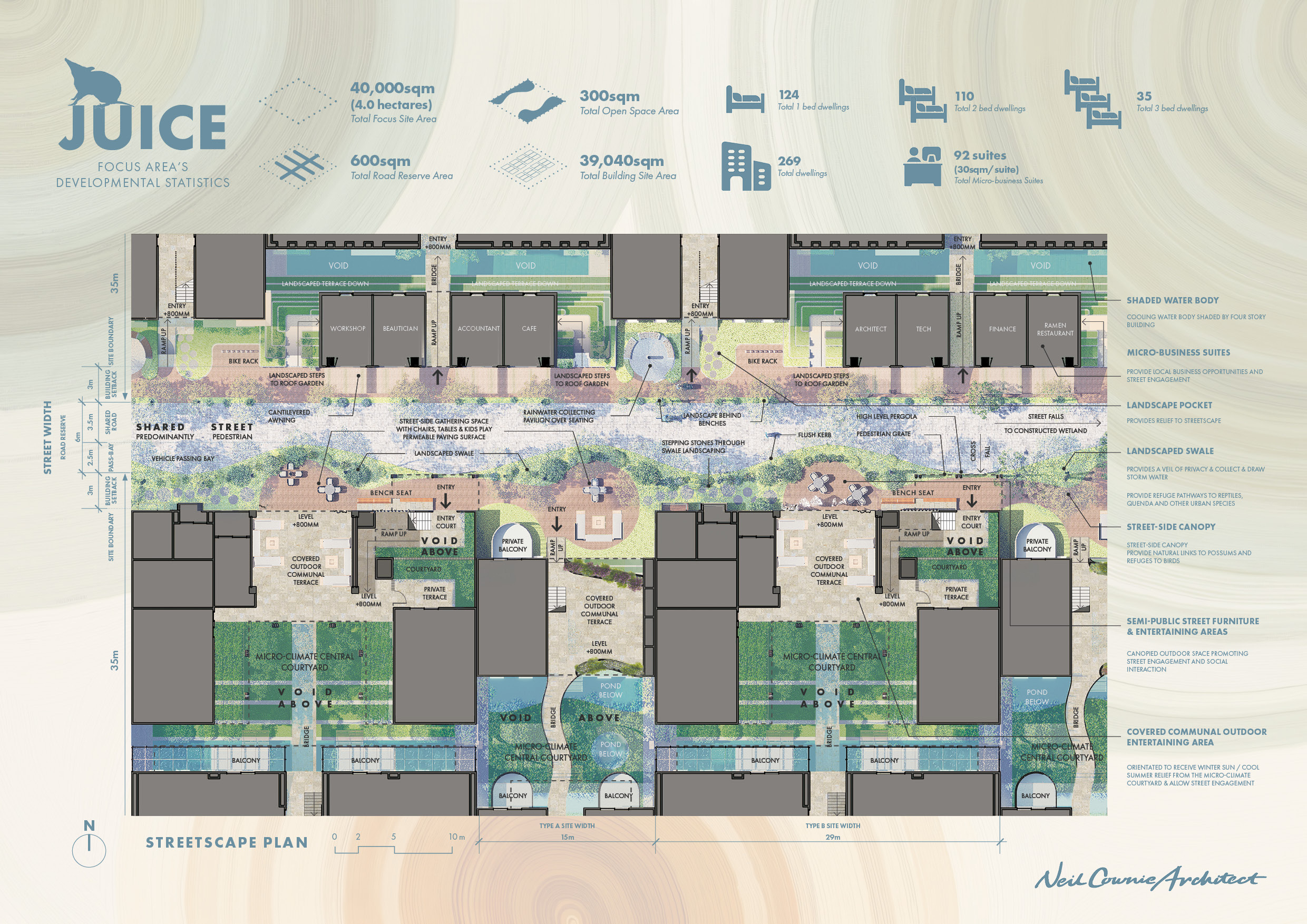
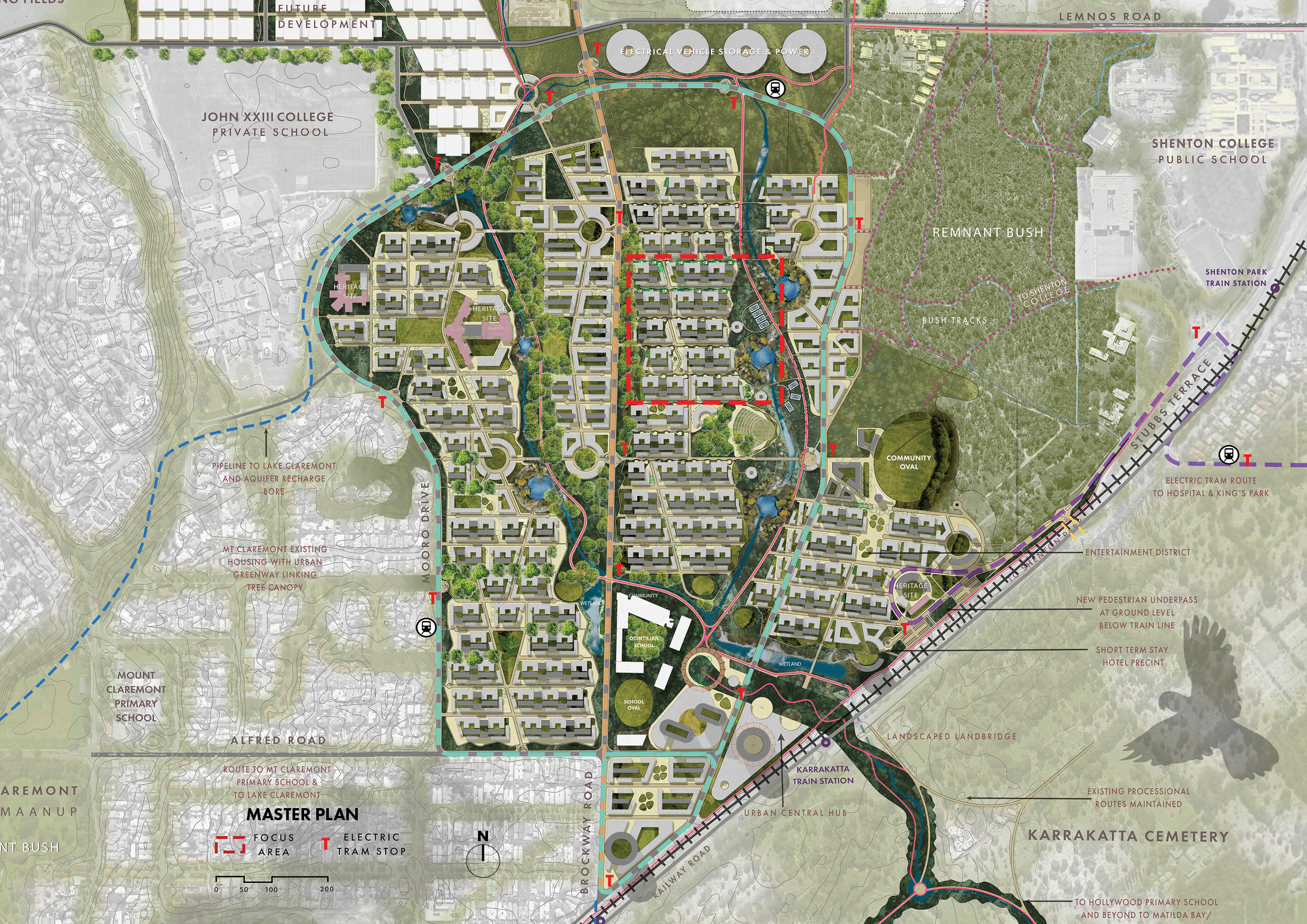
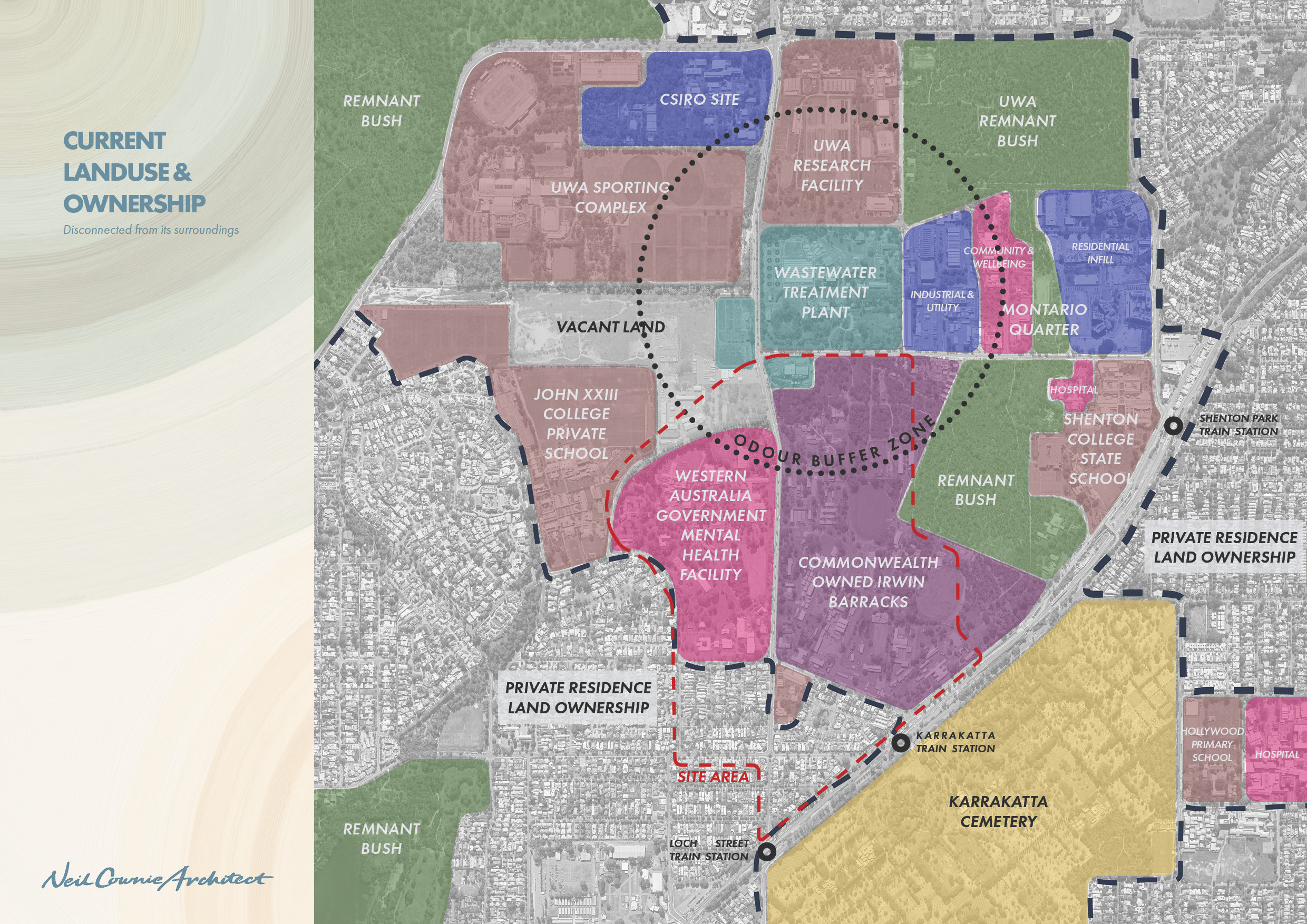
This project titled ‘JUICE’ is the winning entry in an international urban design competition for climate sensitive urban design required to moderate the anticipated climatic conditions forecast for 75-years’ time. The chosen site in Western Australia for this entry is centred on Brockway Road between Karrakatta train station and the Subiaco wastewater treatment centre covering the existing Greylands area and Irwin Barracks. The design provides for in excess of 6,000 new dwellings, predominantly through buildings that are a maximum of four storeys in height.
Following a considerable period of pre-design research it has been so rewarding to have won the Australian Urban Design Centre (AUDRC) and the University of Western Australia (UWA) ‘Future Climate Future Home – Adapt Me Competition’, with the competition achieving an outstanding response, with over 100 submissions from around the world. The competition required entrants to design a small area of urban design that was responsive to the anticipated climatic conditions of 75 years from now in 2099 within each entrants chosen site. The chosen site in my entry is on the Perth Coastal Plain which has the projected 2099 climate conditions of a 4-degree average increase in temperature and 18% to 35% reduction in annual rainfall.
The jury citation was: 'This compelling entry documents an urban precinct in Perth, Australia that takes climate responsive lessons from the past to adapt for the projected future. Such retrospective innovation includes Moorish central courtyards, stepped water wells, flooded communal caverns and mashrabiya window boxes all for passive cooling. Rather than a purely technical exercise, the entry demonstrates creative engagement with increasing temperatures as a springboard to designing delightful, socio-ecologically enriching, innovative urbanism'.
RESEARCH
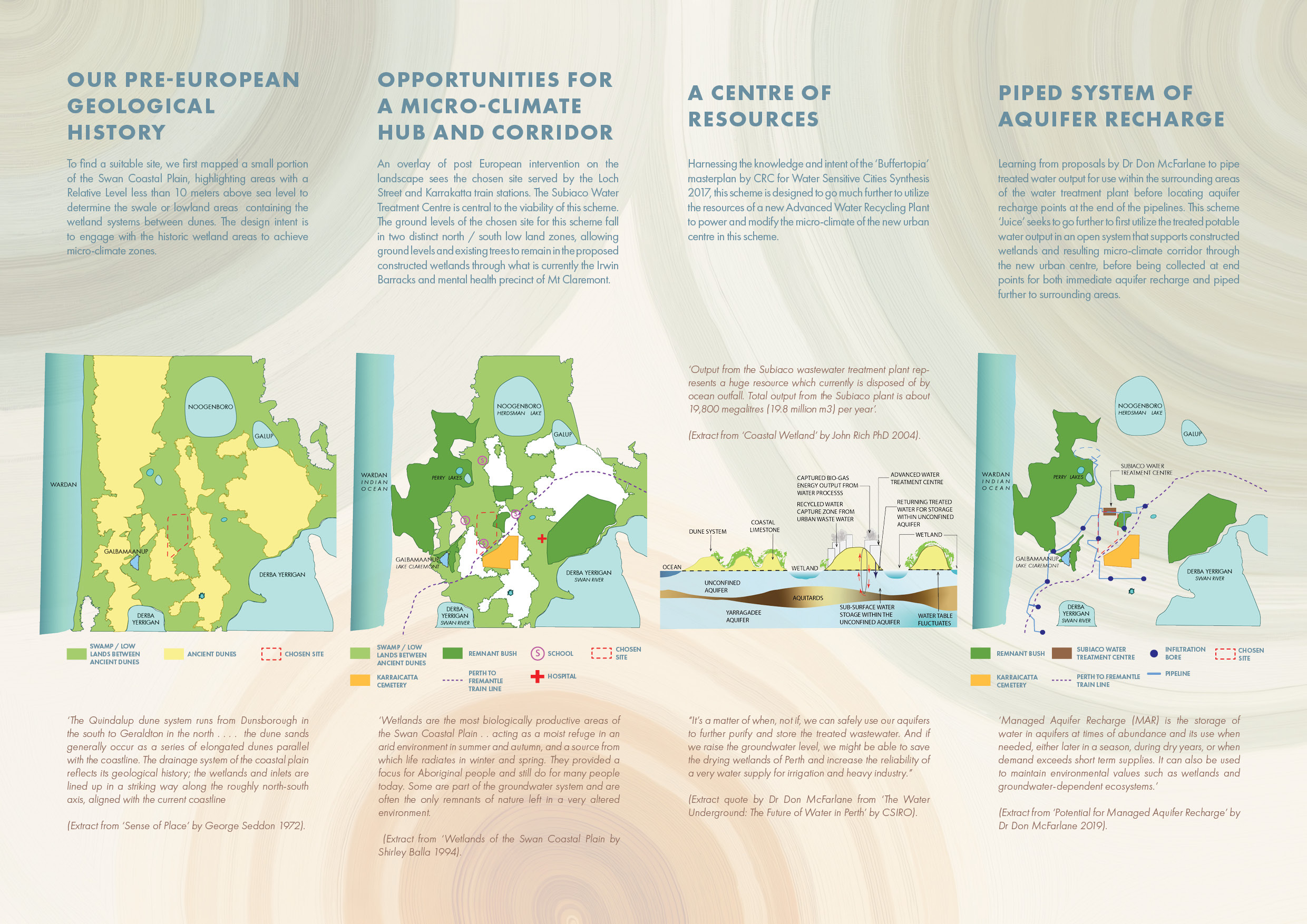
In the initial predesign research I reflected on our past before planning our future, the site on the Perth Coastal Plain was chosen through researching the pre-European geomorphology and hydrology with the design intent to respect and support the pre-existing wetland conditions through current best practice solutions.
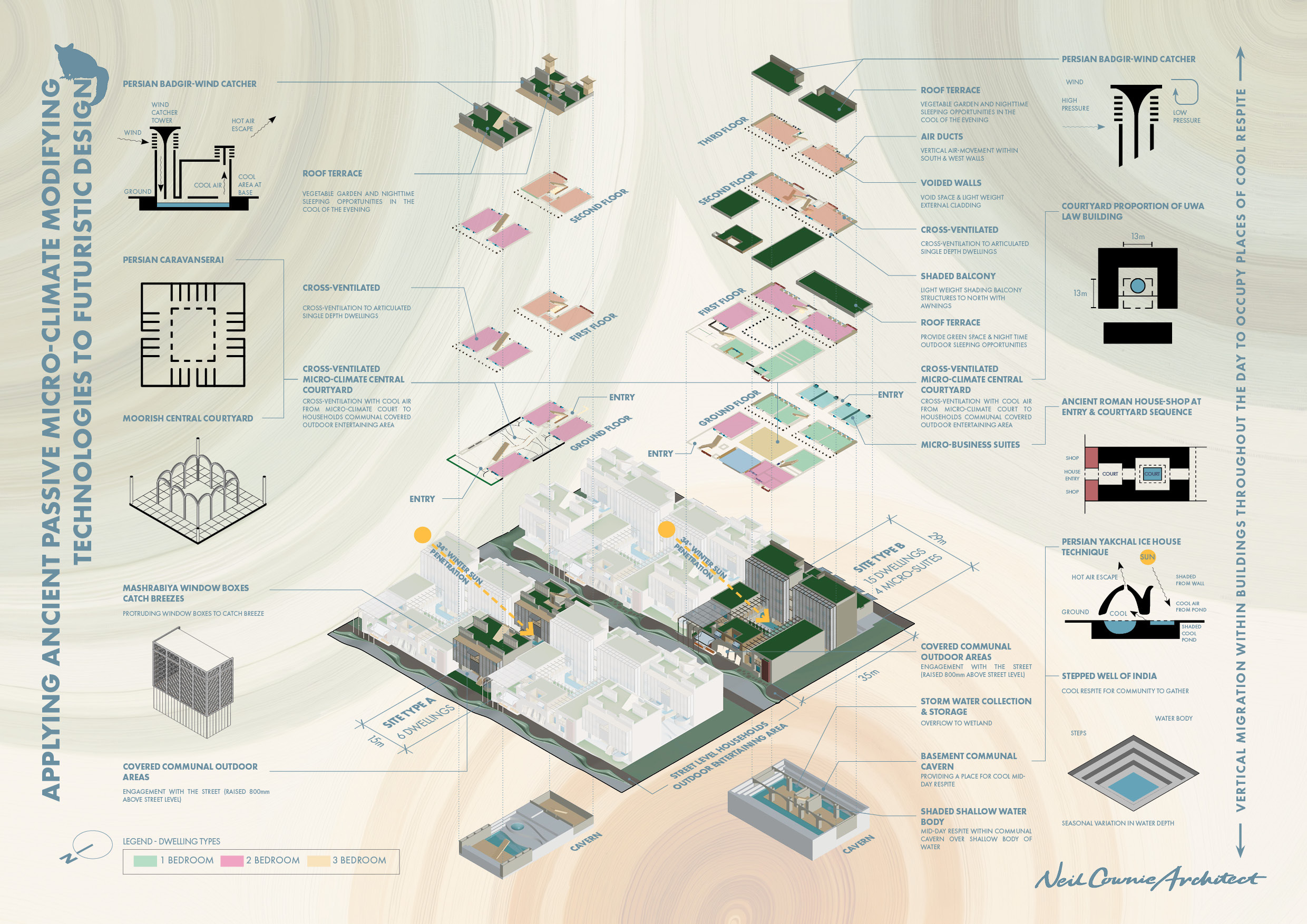
Further research sought an understanding of the successful historic microclimate modifying passive building technologies of Mediterranean and Persian architecture, before applying this knowledge to current best practice urban design and architecture.
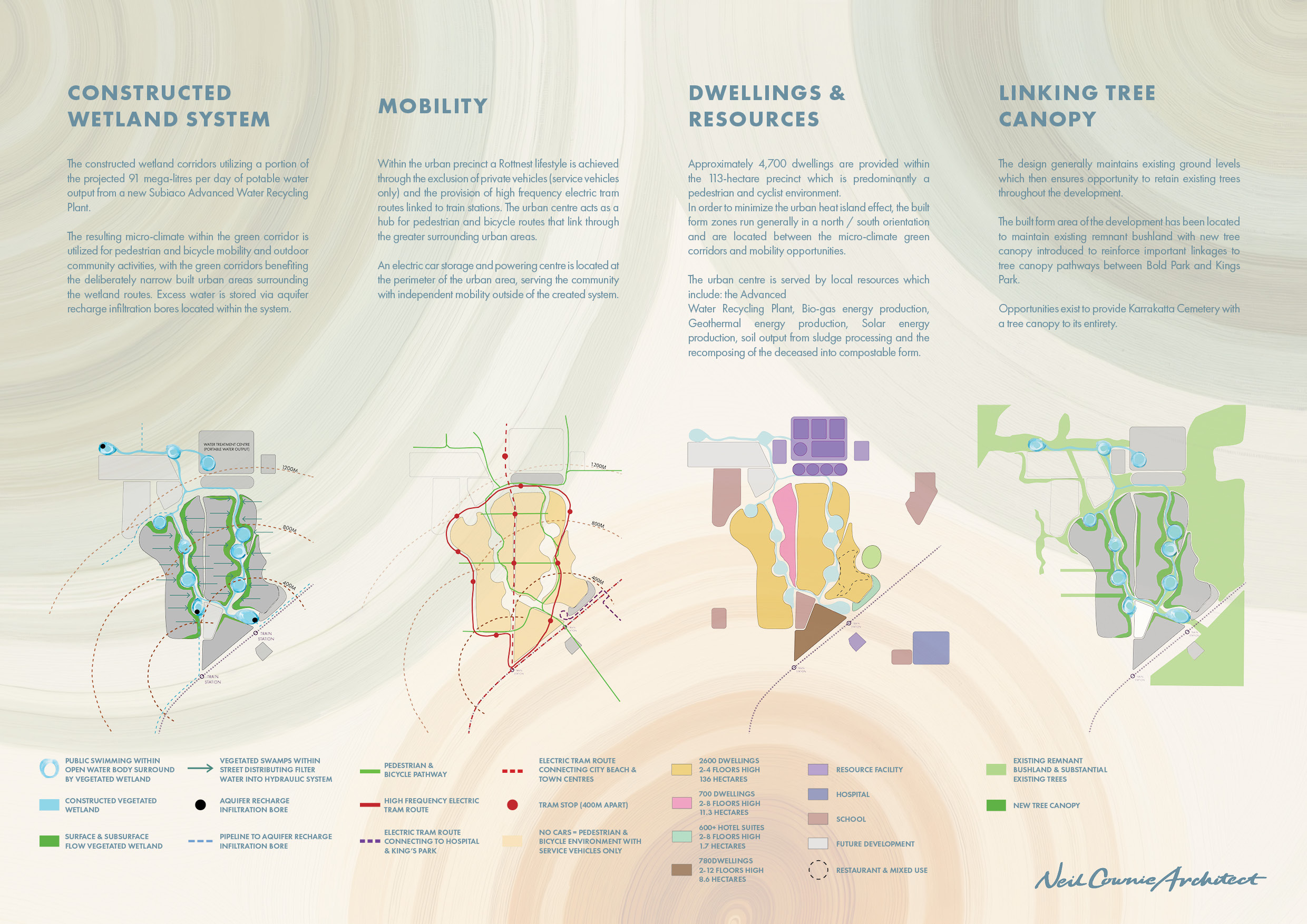
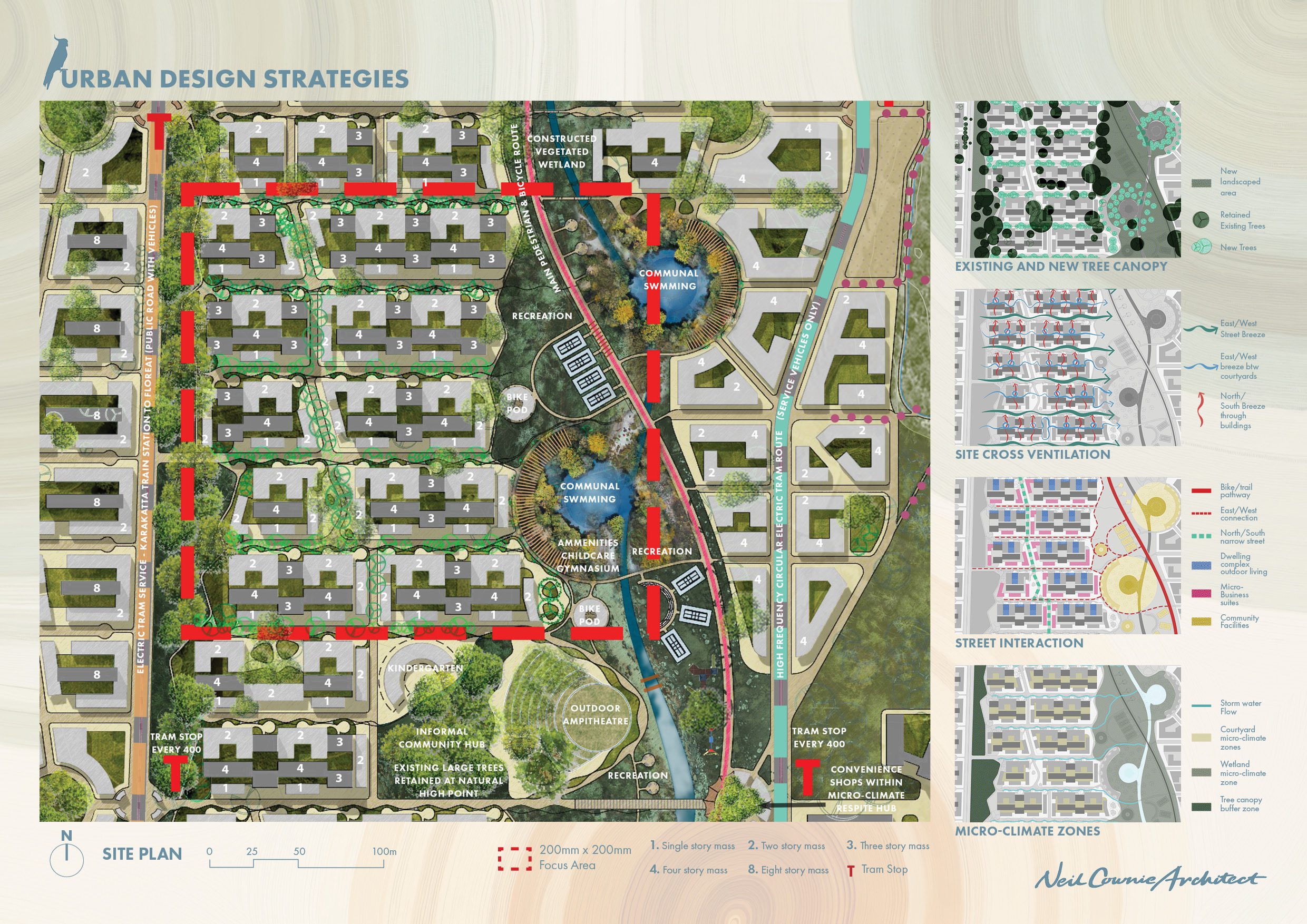
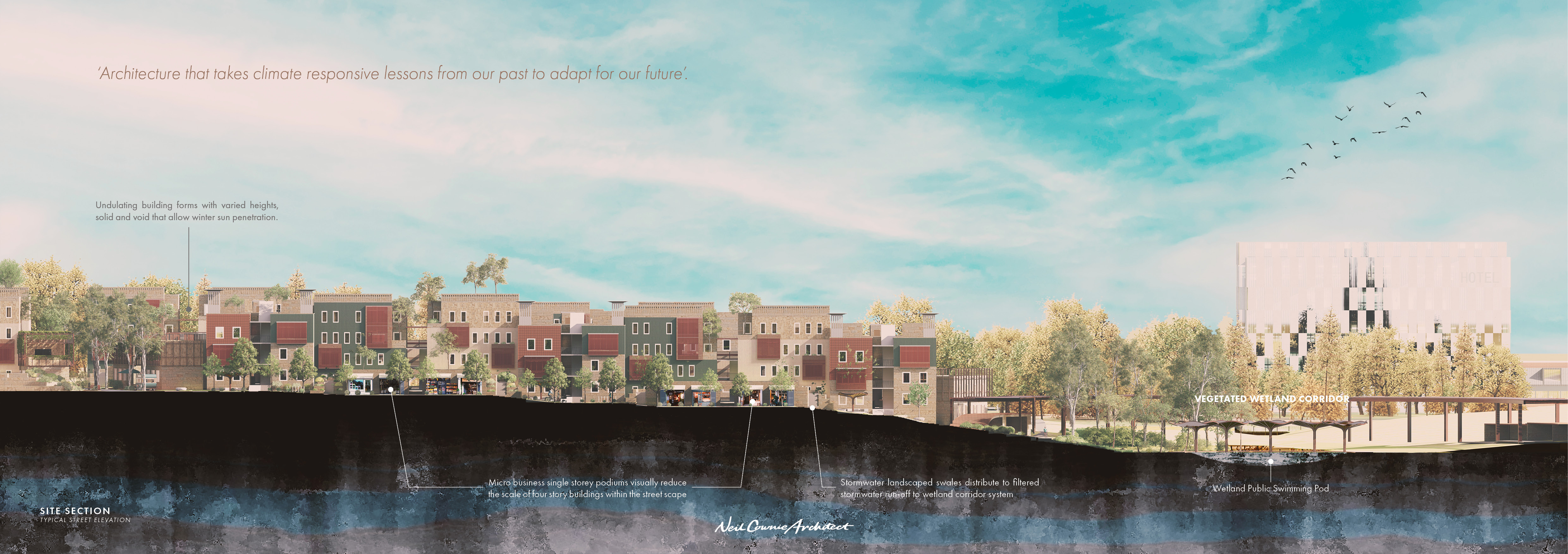
This winning scheme proposes the creation of modified micro-climates at both macro and micro scales through the constructed vegetated wetland green corridors and each buildings climate modifying internal courtyards.
CURRENT BEST PRACTICE
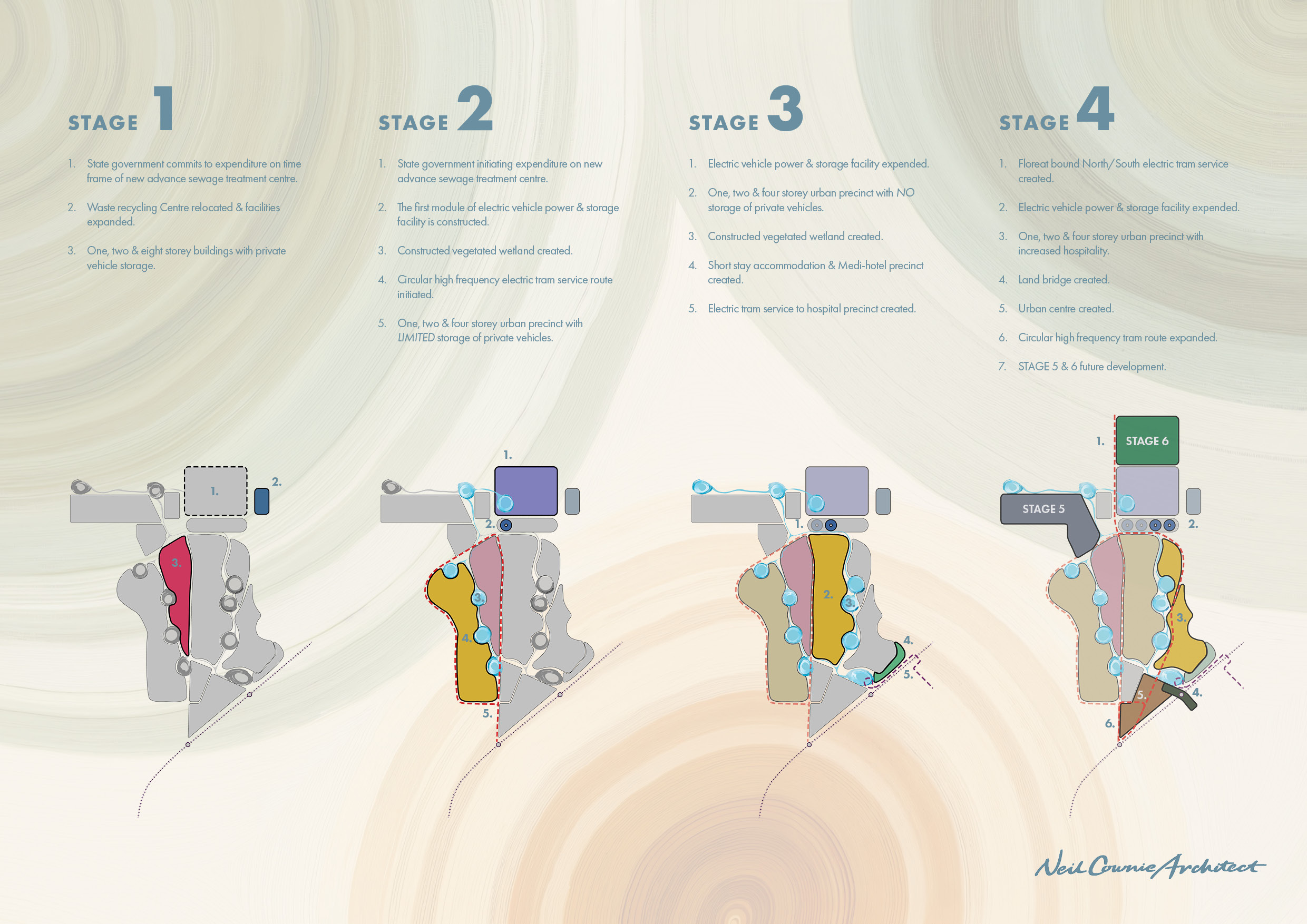
My entry weaves together a diverse range of urban design current best practice concepts, intended to highlight an aspirational living environment that would be achievable even now with state government investment in sustainable water strategies and waste-water recycling solutions and investment in local community public transport electric tram services.
The concept proposes an integrated sustainable ecosystem which considers the human experience along with climate adaption, stormwater management, heat-island mitigation and habitat creation. High frequency sustainable electric powered transport, green corridors, constructed vegetated wetlands, community recreation and local micro-business opportunities to work are just a short walk away from all of the proposed urban areas.
A ROTTNEST LIFESTYLE
The resulting urban experience provides a sustainable egalitarian Rottnest lifestyle with a predominantly pedestrian and bicycle environment (service vehicles only) which is well served by high frequency electric trams, the Perth to Fremantle train line existing train stations at Karrakatta, Loch Street and Shenton Park and easy access to an electric vehicle storage and power centre which allows independent connection to the greater urban area.
Dual path pedestrian and bicycle routes through the proposed new urban area connect to the greater surrounding area thereby allowing access to existing local schools, sporting facilities, local shopping facilities and beyond to the beach and to the river.
The design is based on a concept of ‘compression and release’ whereby community can combine the much-loved urban experiences of European cities (compression) alongside providing the experience of nature through the constructed vegetated wetlands (release).
STATE GOVERNMENT INVESTMENT IN INFRASTRUCTURE
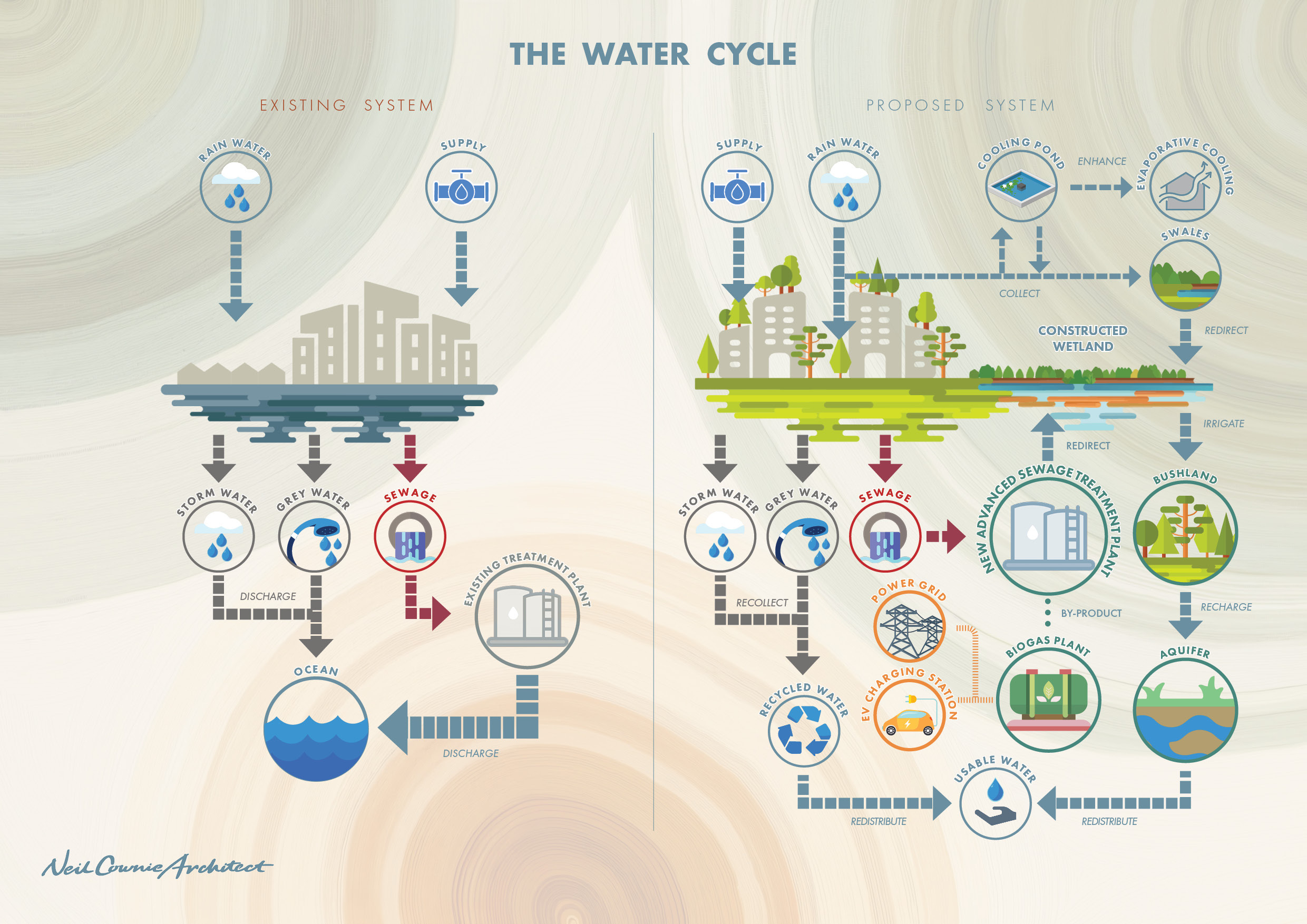
Pivotal to the ability to achieve this aspirational living environment is state government expenditure on a new advanced sewerage treatment centre at the existing Subiaco site which would then provide 100% output of drinking quality water, and a source of energy in the form of biogas. Turning what is currently seen as waste, sewerage and storm water, into a valuable resource. This concept is transferable to many other waste treatment centres around the state where local community would similarly benefit.
Further, investment in such infrastructure provides opportuntiy for business development such as a third party owned electric vehicle storage and power centres which are sustainably powered via the biogas production from the proposed new Advanced Wastewater Treatment Centre.
WETLAND HYDROLOGY
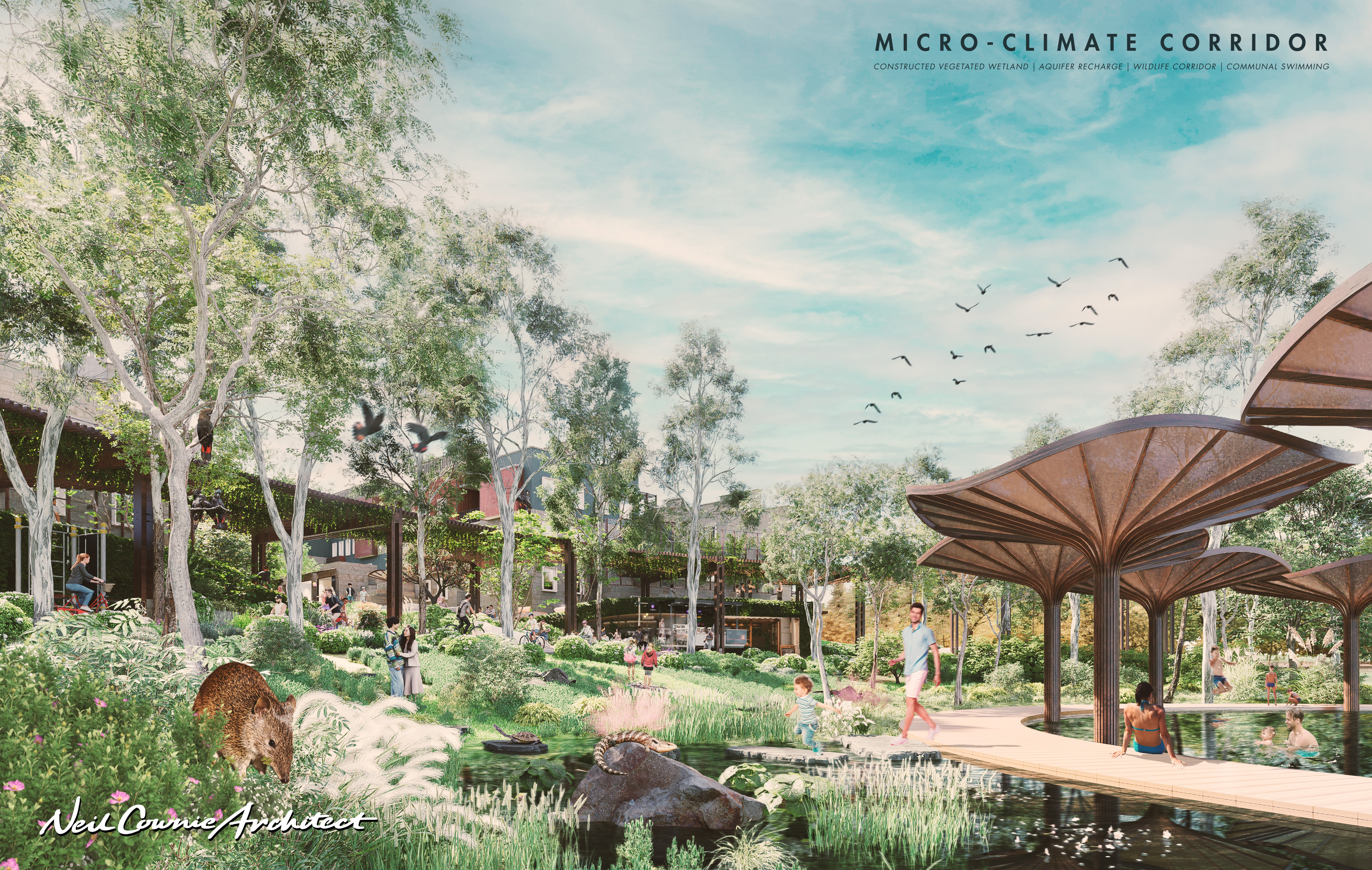
Following the essence of Kep Katitjin – Gabi Kaadadjan Waterwise action plan 3 and having researched the work of local hydrologists such as Dr Don McFarlane, it became abundantly clear that the preservation of our Perth Coastal Plain wetlands is pivotal to our ability to survive in the future. My scheme which is titled ‘Juice’ (inspired by the Tim Winton novel of the same name) uses the potable water output from the advanced sewerage treatment centre to create ribbons of constructed, vegetated wetlands with continuous tree canopy which create a mirco-climate between the areas of housing to moderate the experienced temperature. These wetlands then accommodate outdoor recreation, communal swimming and community-based activities through which dual path pedestrian and bicycle routes provide easy access for the community and link to surrounding areas. Most importantly, at the end of the route of the potable water through the filtering wetland system, reverse-bores are used to store the water in our superficial aquifer. By using our superficial aquifers as water storage facilities, we are ensuring the survival of our remaining wetlands and tree canopy while ensuring that water remains accessible within the aquifer for future use.
The vegetated constructed wetlands also provide important linkages for flora and fauna as the proposed connecting tree canopy, plays its part in a long-term goal of linking the remnant bushland of Kings Park alongside the river to the remnant bushland of Bold Park by the ocean.
RECONNECTING WITH A PAST THREAD OF ARCHITECTURE
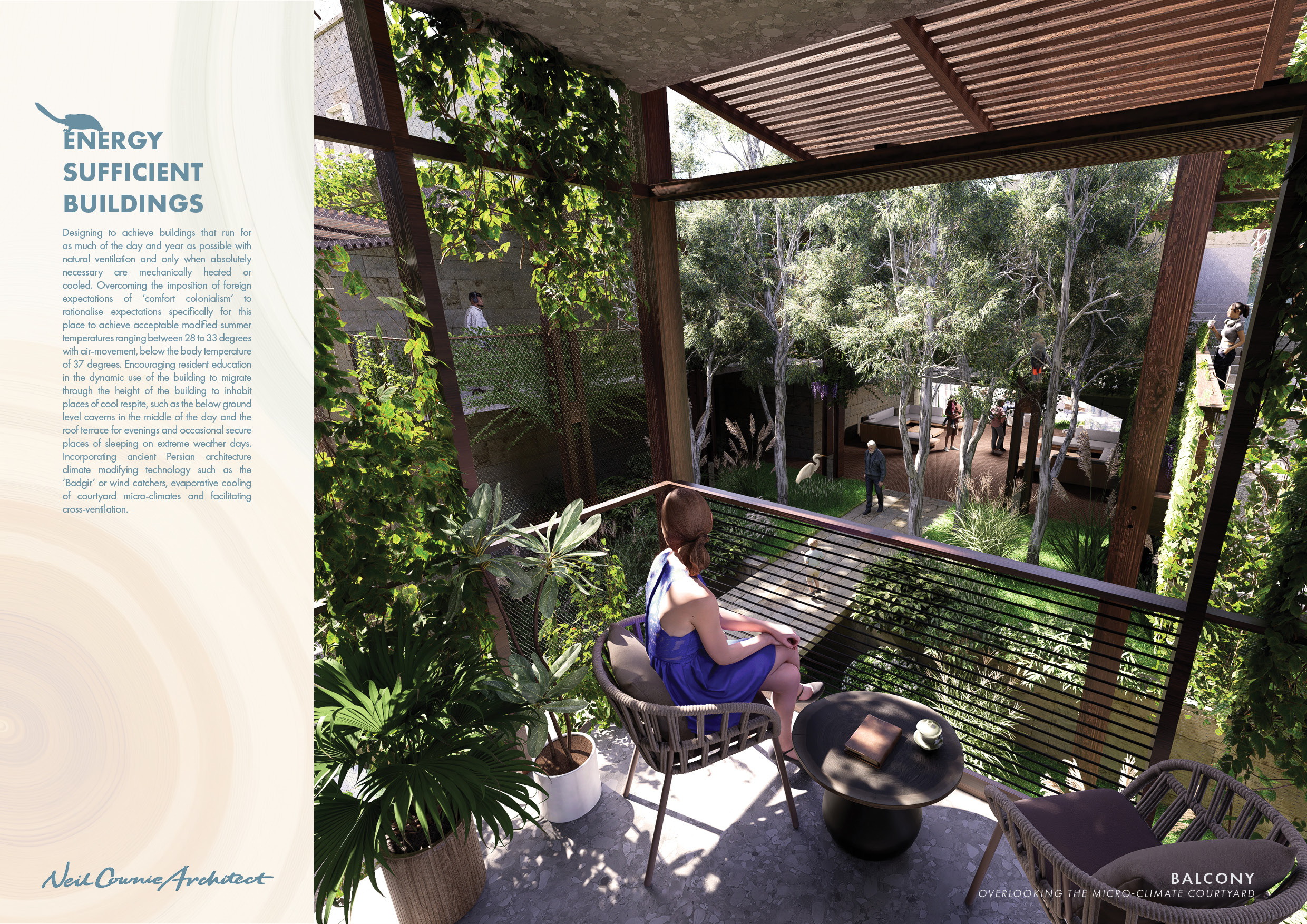
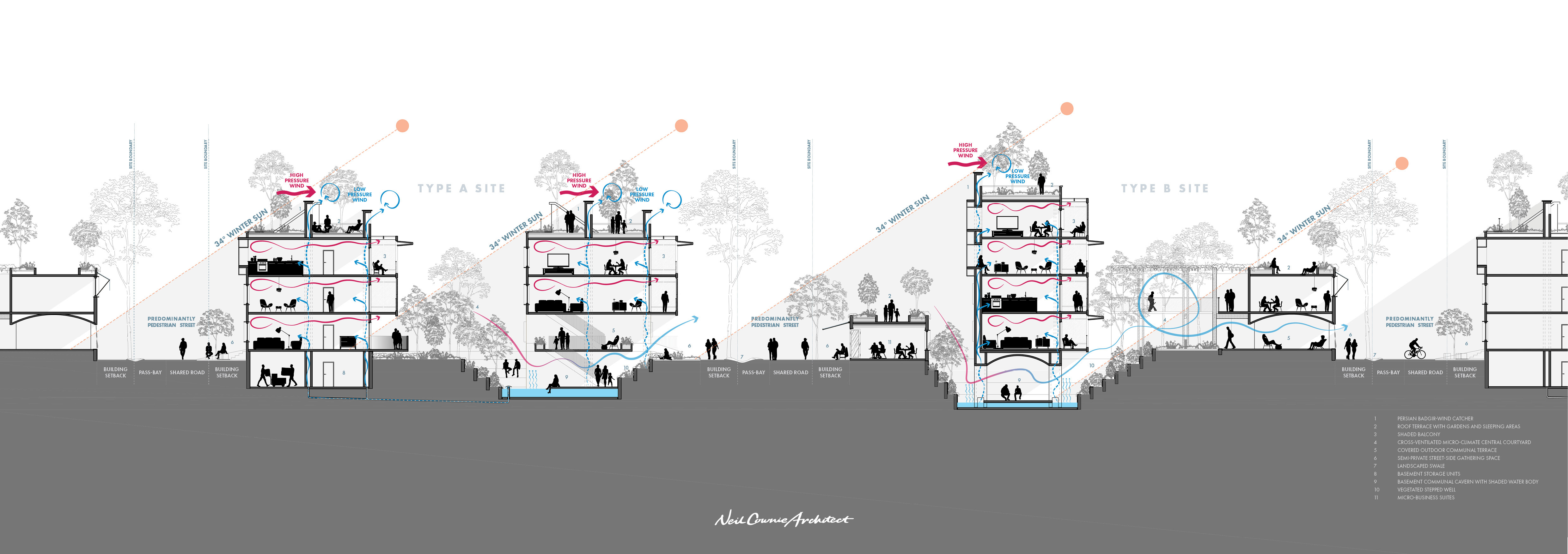
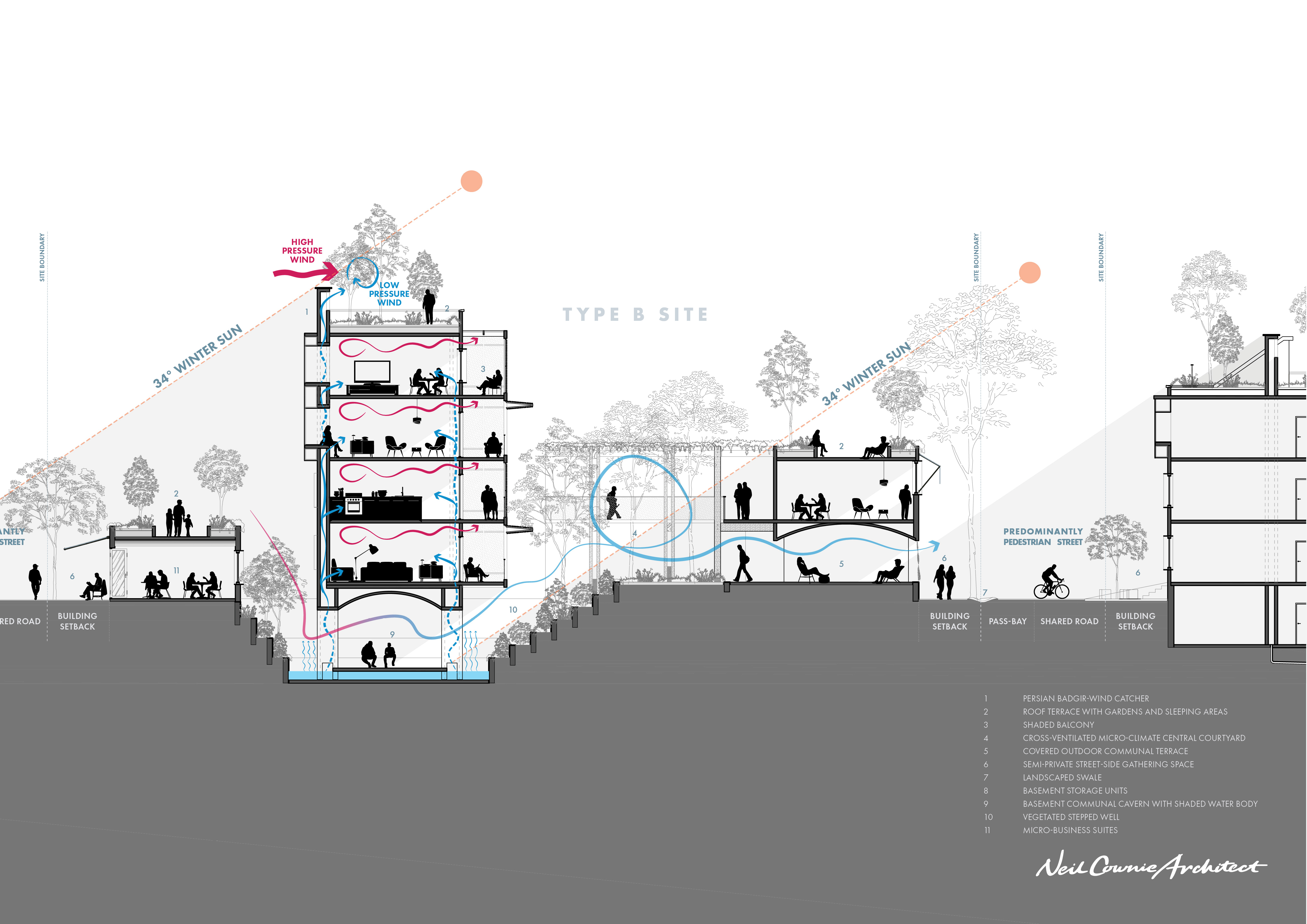
Further research sought an understanding of the successful historic microclimate modifying passive building technologies of Mediterranean and Persian architecture, before applying this knowledge to current best practice urban design and architecture to propose energy sufficient buildings. Within the proposed urban centre buildings are designed to run for as much of the day and year as possible with natural ventilation and only when absolutely necessary are mechanically heated or cooled – energy sufficient architecture.
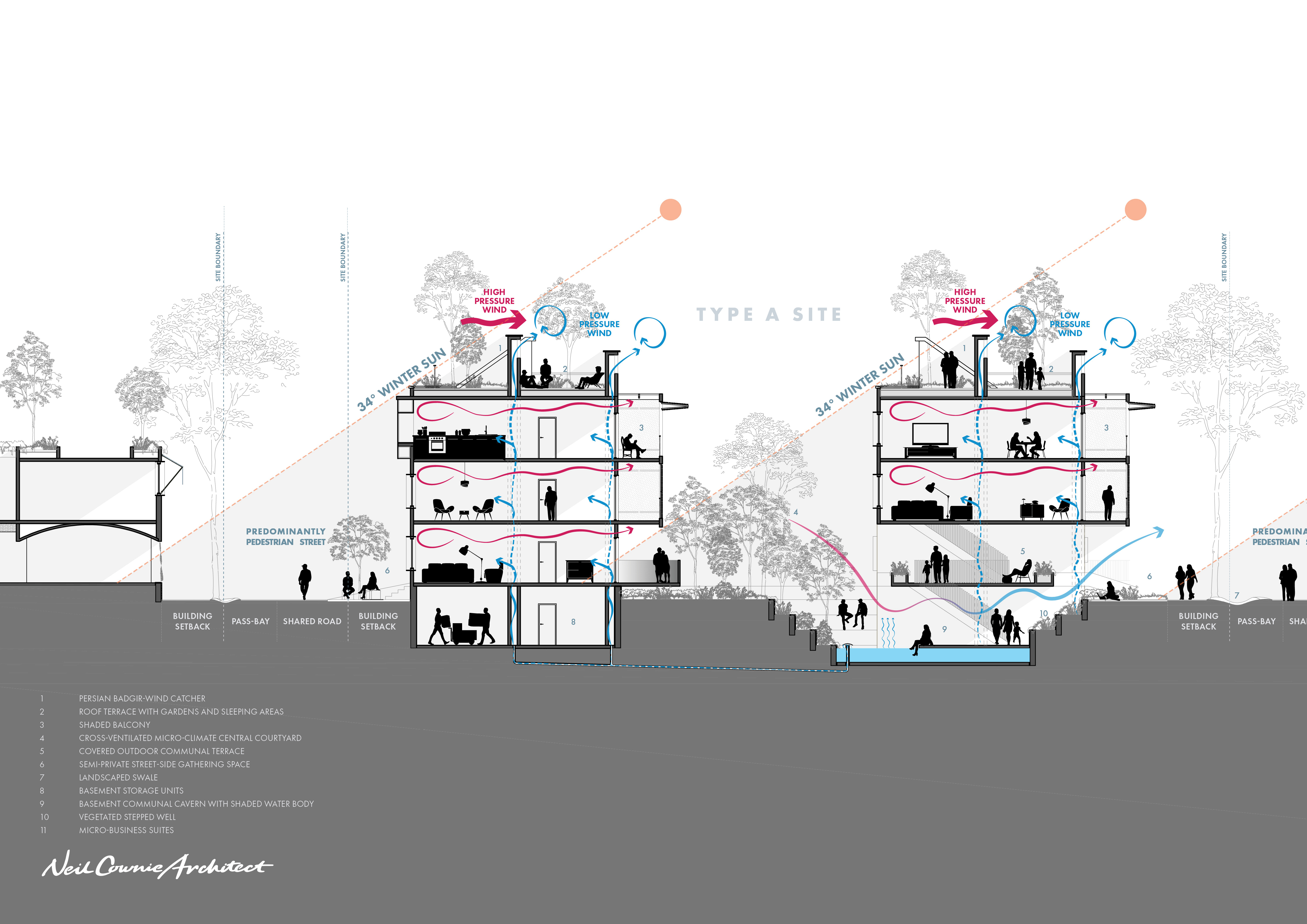
Overcoming the imposition of foreign expectations of ‘comfort colonialism’ to rationalise expectations specifically for this place to achieve acceptable modified summer temperatures ranging between 28 to 33 degrees with air-movement, below the body temperature of 37 degrees. Encouraging resident education in the dynamic use of the building to migrate through the height of the building to inhabit places of cool respite, such as the below ground level caverns in the middle of the day and the roof terrace for evenings and occasional secure places of sleeping on extreme weather days. Incorporating ancient Persian architecture climate modifying technology such as the ‘Badgir’ or wind catchers, evaporative cooling of courtyard micro-climates and facilitating cross-ventilation.
Other techniques that have informed this architectural response include the micro-climates of the Moorish courtyards, the cooling ventilation systems of the Mashrabiya (window boxes) with the evaporative cooling Zeer clay pots, Persian ice houses (Yakhchal) and their use of shaded bodies of water and transfer of cool air, the transfer of cool water via the piped below ground Qanats of ancient Persia, Roman house courtyards, breezeways and the communal step wells of India. The urban design typical of the ancient Roman house with their integration shop fronts into the house street frontage, associated with the entry to the house – small places of business integrated into the houses.
ENCOURAGING SOCIAL INTERACTION
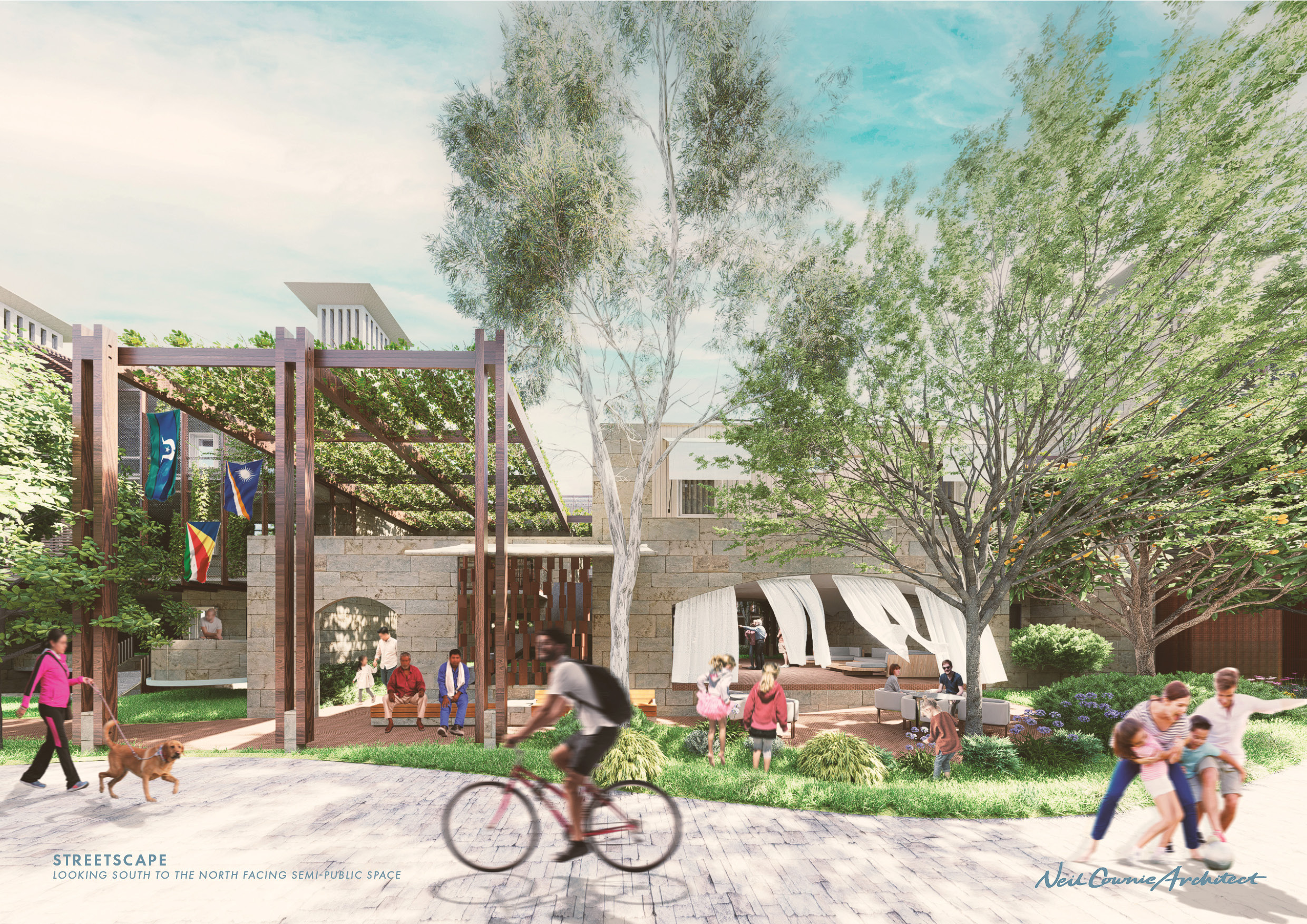
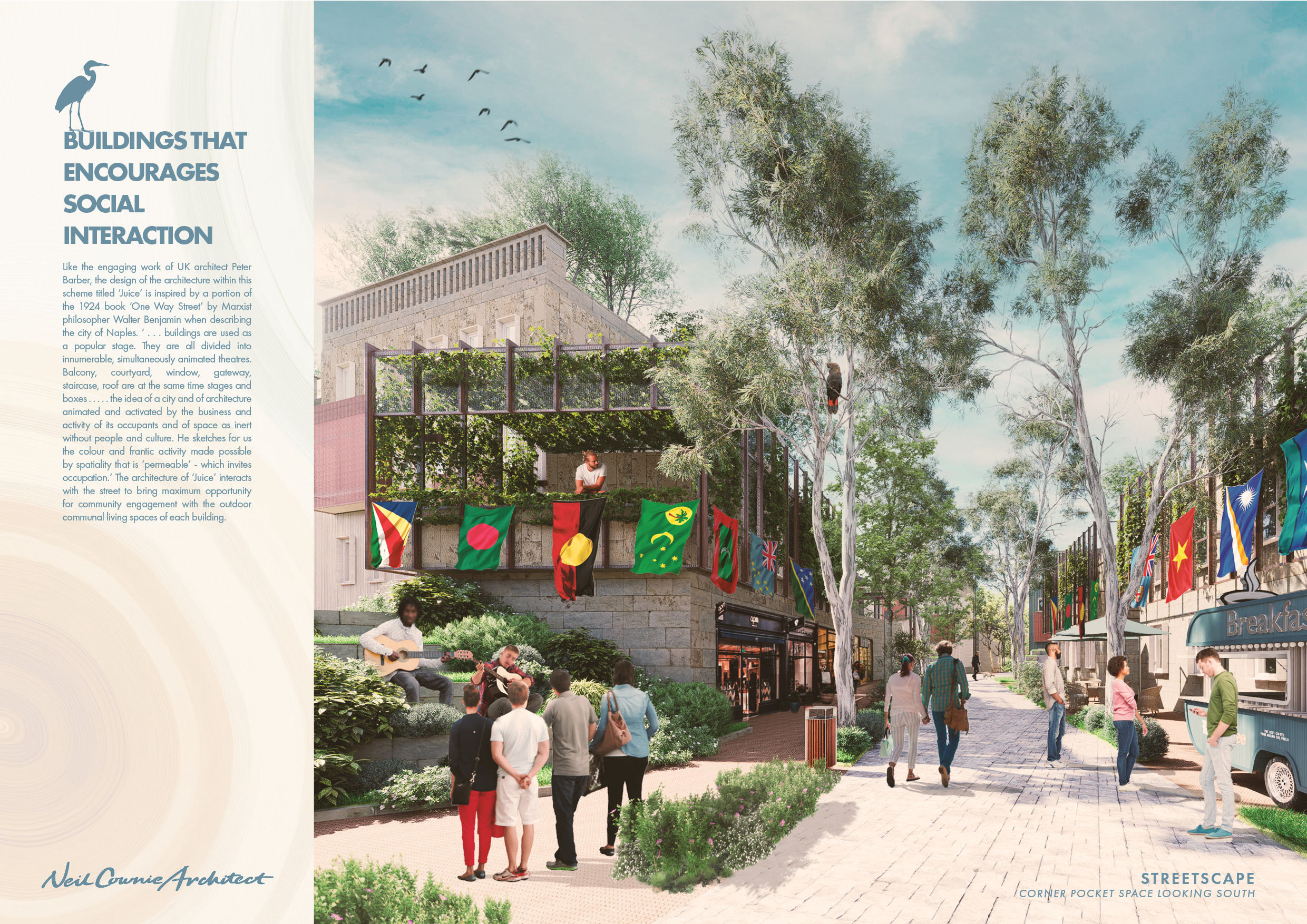
The architecture of ‘Juice’ interacts with the street to bring maximum opportunity for community engagement with the outdoor communal living spaces of each building.
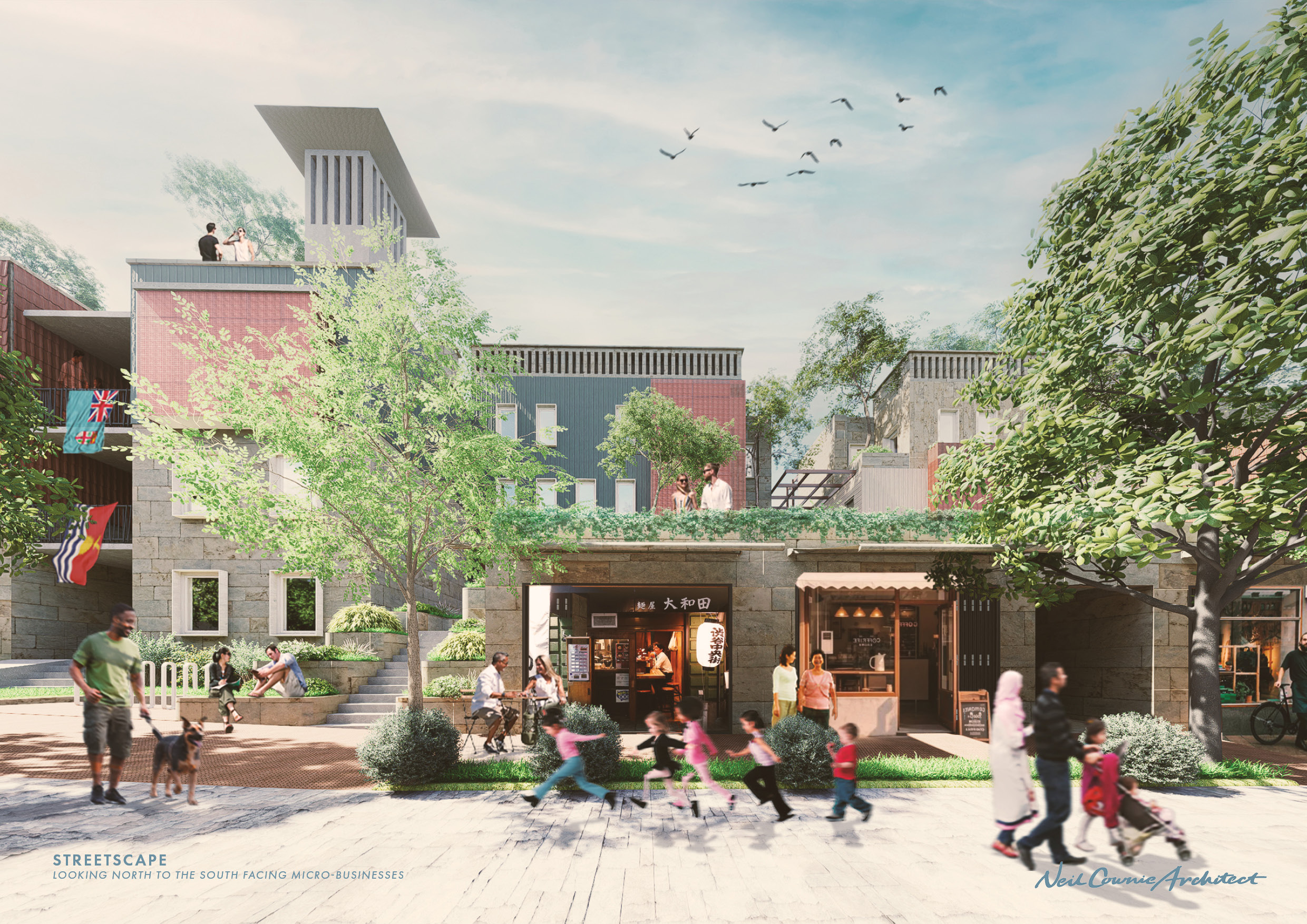
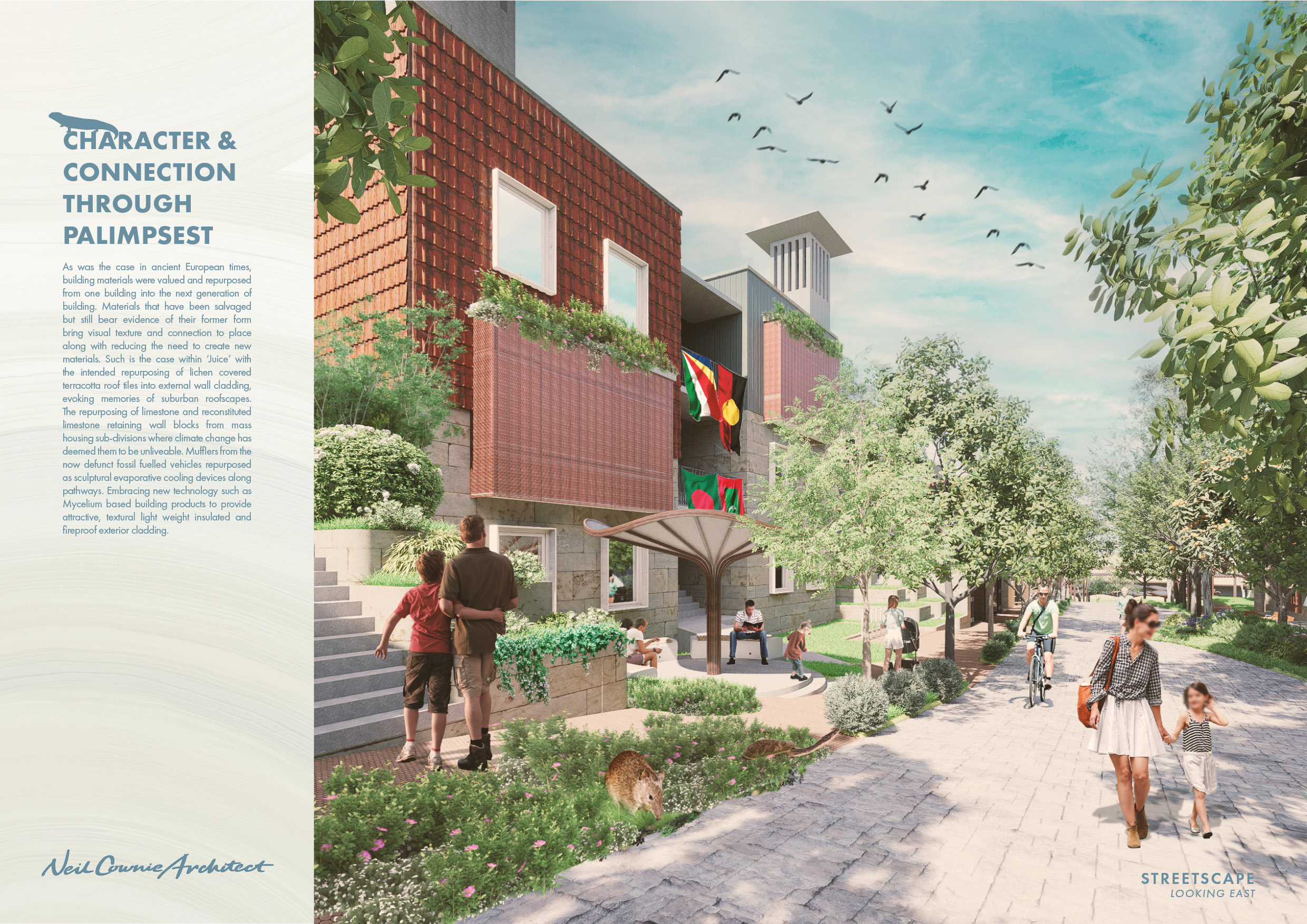
The local streets are occupied by pedestrians and cyclists along with children who have opportunity to use the streets to play soccer, kick a footy or to play hopscotch. Vehicle access is limited in width to allow for one vehicle with pockets of wider road at intervals for overtaking.
Micro-business opportunities have been evenly distributed throughout the locality, located in the main to the north side of the east / west oriented streets (in the shadow of the taller building mass) while also located along the north / south more intimate streetscapes.
Within the walkable 20-minute urban area, community is provided access to local facilities which include: – schools, kindergartens, day care, recreation, sporting facilities, shopping centres, medical clinics, integrated generations and aged care.
HISTORY OF PLACE & PEOPLE
KARRAKATTA
I have been unable to find record of the history of Noongar people in the immediate vicinity of the chosen site, however in the book ‘That Was My Home’ by Denise Cook there is reference to the ‘Shenton Park camps’ which are shown as being located in close proximity to the current location of the Subiaco Sewerage Treatment Centre, north of Lemnos Street. There were additional camps to the north of this location in what is now the Underwood Avenue Bushland. Both of these sites have been registered under the Aboriginal Heritage Act 1972. ‘According to Noongar Elders consulted for an Aboriginal heritage survey in 1988, the camps in the Lemnos Street area were occupied from about the 1920’s until the 1950’s. There was no natural source of water there, so the camps were probably only established as the expansion of settlement pushed Noongar people further to the fringes of development.’
The area around the now Karrakatta cemetery was referred to as being the Noongar name ‘Karrakatta’ prior to the establishment of the cemetery. There are varying references to the meaning of the name which include ‘hill of spiders’, ‘hill of crabs’. There are also references to the name stemming from two separate Noongar words ‘karra’, meaning something like a bird, root or orchid and ‘katta’, meaning hill. Other names are recorded for the area which include Yongariny, meaning place for catching kangaroos and Gennungin Bo, meaning place for looking a long way and finally Karlkarniny, meaning fireplace.
From ‘Landgate History of Metropolitan Suburb Names’: ‘The termination katta is well known and is given as the Aboriginal word for a hill, or the top of any height, in the early Aboriginal vocabularies. The karra is more difficult as it may be derived from - Karri -a crab, Karak - the red-tailed black cockatoo, Kara - a spider, Karh-rh - an orchid with an edible root. The meaning of the combined word could therefore be the hill, or top of the hill, where the orchid with the edible root is found, or the hill frequented by the red-tailed black cockatoo, or the hill where spiders are found and so on. It is not definitely known which the exact area was called by the Noongar people "Karrakatta" but it is generally thought to be the top of Mount Eliza’.
I think that if in doubt, let’s all back the endangered red-tailed black cockatoo’s when it comes to the name Karrakatta.
Interestingly the Karrakatta Club was founded in 1894 prior to the establishment of Karrakatta Cemetery, showing that there was a general awarness of the name Karrakatta. The name Karrakatta was gtaken as the name for the cemetary as the area was already refered to by that name.
WASTEWATER TREATMENT PLANT
The wastewater treatment centre began at the site of the Subiaco Wastewater Treatment Plant in 1927, with the plant becoming the third largest in Western Australia and serving the Perth CBD and surrounding western suburbs. It underwent a significant $48 million upgrade completed in 2018, which increased its capacity to support regional growth. Now, the plant treats wastewater, producing recycled water and other by-products like compost, and is exploring potential future uses for groundwater replenishment. The sewerage treatment plant is surrounded by 252 hectares of ‘odour buffer zone’ in which lies opportunity for future activity. There is great opportunity to harness the treated / recycled water that is processed by the Sewerage treatment centre.
In 2017 sewerage inflows to the Subiaco Waste Treatment Centre were 60 million litres per day of which 2.3 million litres per day is recycled and 58million litres a day is discharged into the Indian Ocean. Stormwater represents another untapped resource at Subiaco. Local and regional drainage networks, including piped and open drains, discharge to the ocean, Swan-Canning River, or to lakes. The Subiaco main drain traverses the site and is estimated to discharge between 1.5–3 billion litres each year to the ocean. If only 25 percent of this flow was captured, the volume could be enough to irrigate up to 100 hectares of public open space.
IRWIN BARRACKS
Irwin Barracks was acquired by the Colonial Government of Western Australia in the 1880’s for the storage of two seven-inch coastal artillery guns. In 1895 the Karrakatta reserve was upgraded as a camp and training ground for the Western Australian Volunteer Forces a purpose for which it still serves to this day with its use by Regular and Reserve units.
GRAYLANDS HOSPITAL
The Graylands Hospital originated as the Claremont Hospital for the insane with Fortescue House constructed in 1908, replacing the Fremantle Asylum to become Western Australia’s main mental health institution in 1972. Today the hospital serves as a psychiatric teaching hospital, State Forensics Mental Health service centre and community mental health services centre.
KARRAKATTA CEMETERY
Karrakatta Cemetery, located in the Perth suburb of Karrakatta, Western Australia, opened for burials in 1899. The name Karrakatta was not created for the cemetery, as the area was already known by this name, being a Noongar people’s name for the place.
Karrakatta replaced the East Perth Cemetery as the main burial ground for Perth and the metropolitan area. The initial conditions were primitive, with no proper road access and funerals often arriving by rail or cart.
The first burial took place at Karrakatta Cemetery on April 24, 1899. The deceased was a young wheelwright named Robert Creighton who died of typhoid fever at the age of 29.
KARRAKATTA TRAIN STATION
The Perth to Fremantle train line opened in 1881 with the Karrakatta train station giving access to the cemetery once established after 1899.
COMPETITON JURORS STATEMENT
The winners were determined using the following criteria:
• The entrant’s working knowledge of established climate-sensitive urban design strategies.
• The developments of innovative approaches to climate-sensitive urban design.
• The creative engagements with increasing temperature as a springboard for designing socioeconomically enriching, diverse and delightful urban proposals.
Rather than treating the assessment as a purely technical exercise, the judges recognised entries that used climate adaptation as an opportunity to imagine neighbourhoods that operate well environmentally while offering rich and engaging urban experiences.
From the jury: Neil Cownie’s scheme titled ‘Juice’ was a well-deserved first place winner.
The jury citation was: This compelling entry documents an urban precinct in Perth, Australia that takes climate responsive lessons from the past to adapt for the projected future. Such retrospective innovation includes Moorish central courtyards, stepped water wells, flooded communal caverns and mashrabiya window boxes all for passive cooling. Rather than a purely technical exercise, the entry demonstrates creative engagement with increasing temperatures as a springboard to designing delightful, socio-ecologically enriching, innovative urbanism.
COMPETITION BRIEF
The competition brief:
- Select a 200 x 200m site in a city or town worldwide. This site can be developed or undeveloped in its existing state.
- Research projected 2099 climate conditions of your chosen city or town using IPCC’s Sixth Assessment Report and Interactive Atlas, assuming an SSP3-7.0 (+4°C) scenario.
- Adapt the site to projected climate conditions, focusing on extreme temperatures.
Commentary on climate change is often alarmist and can employ inflammatory language. Words like ‘catastrophe’, ‘threat’ and ‘urgency’ are widely used. The problem is that such commentary can lead to denial, paralysis, apathy, or even perverse reactive behaviour.
At the same time, a major blockage to transformational change is a lack of urban design vision that can capture the public imagination for more sustainable and climate-adapted futures. This visionary dimension is critical because people are unlikely to discard a flawed paradigm until a more alluring model can be found.
Urban design should play a significant role in exploring what this model could be. For example, how should climate change-adapted urban precincts look, feel, and perform across a broad swathe of climate regions in the near and distant future? How do we move beyond pragmatic adaptation to climate change? Indeed, how could climate change adaptation be a catalyst for creating diverse, dense and delightful neighbourhoods? Moreover, how can climate adaptation address socioeconomic inequities compounded by climate change?
The competition aims to engage current experts and the next generation of designers and planners with climate-sensitive urban design techniques and elicit innovative climate-sensitive urban design solutions.
AKNOWLEDGEMENTS
Acknowledgement of competition team member: Rex Cheng.
Acknowledgement of participants in peer review through the developmental stage of the design process:
Dr Don McFarlane – Adjunct Professor UWA – Hydrologist.
Jack Collard – Noongar knowledge holder.
Peter Spencer – Water Corporation Manager Engineering Advisory.
Acknowledgement of participants in post design stage interaction:
- Lijun Mo – Water Corporation – Head of Future Water Resources.
- Dean Mudford – CEO Development WA.
- Bruce Thompson – Director Planning & Development – City of Nedlands.
- Leah Elliott – Senior Policy Adviser – Department of Planning and Development – Ministerial office of Hon. John Carey MLA.
- Hon. Dr Brad Pettitt MLC - Western Australian Greens Parliamentary Leader.
- Karissa Fyfe – Senior Policy Adviser for Water – Ministerial office of Hon. Don Punch MLA.
- Tina MacDonald – Senior Policy Adviser Climate Resilience – Ministerial office of Hon. Don Punch MLA.
- Joe Wyder – Manager Energy Industry Development for the Department of Energy and Economic Development – Ministerial office of Hon. Amber- Jade Sanderson MLA.
COMPETITION JURORS
The competition jurors were:
- Dr Julian Bolleter (Urban Design) – Director of the Australian Urban Design Research Centre – UWA.
- Dr Silvia Tavares (Urban Design) – Founder and Co-lead of the Bioclimatic & Sociotechnical Cities Lab – University of the Sunshine Coast.
- Emerita Professor Billie Giles-Corti (Public Health) – Distinguished Professor, VC Professional Research Fellow and Director of the Healthy Liveable Cities Lab at RMIT.
- Professor Maria Ignatieva (Landscape Architecture) – Professor of Landscape Architecture, UWA & President of the Urban Biodiversity & Design International Network.
- Andrew Lilleyman (Architecture) – Director of ARM Architecture.
- Dr Robert Cameron (Smart Cities) – Associate Lecturer at the Australian Urban Design Research Centre, UWA.
Accolades
Australian Urban Design Research Centre (AUDRC) - University of Western Australia
2026: 'Future Climate Future Home - Adapt Me Competition' - First Place